What the Midjourney V8.2 edit model carried from one image to the next
A book-cover designer testing Midjourney's V8.2 Editor supplied a rough layout, then added a second image to steer the look. The designer judged the resulting drafts useful for composition. When they asked the Editor to move subjects already present in finished artwork, all three examples they discuss fell short. A manual cut-and-paste pass followed by another edit gave a mixed result. The same account captures two different design tasks. A sketch can guide a fresh composition, while a revision to an approved composition depends on precise placement and preservation. GoOnWrite's illustrated editor tests
What does the evidence show?
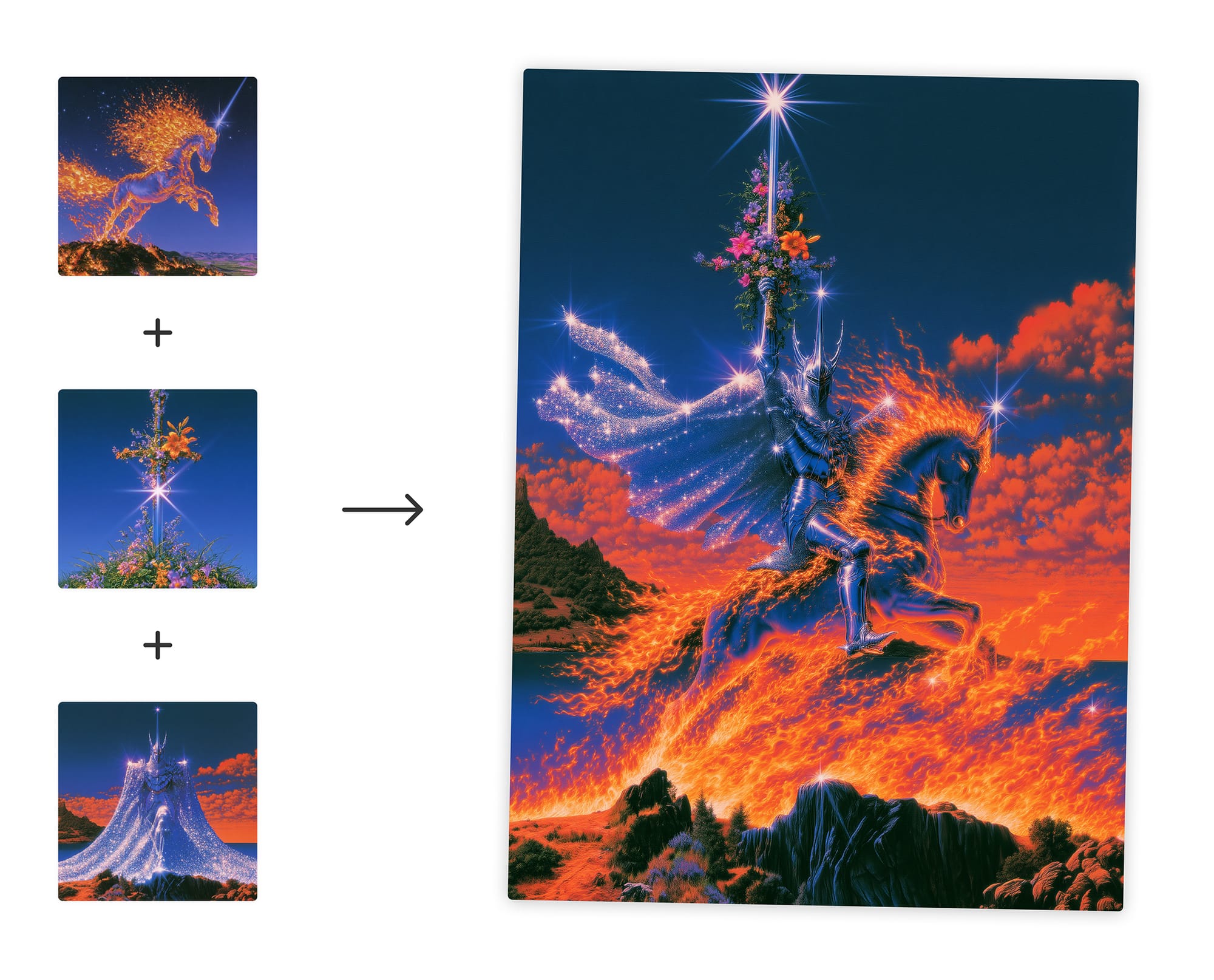
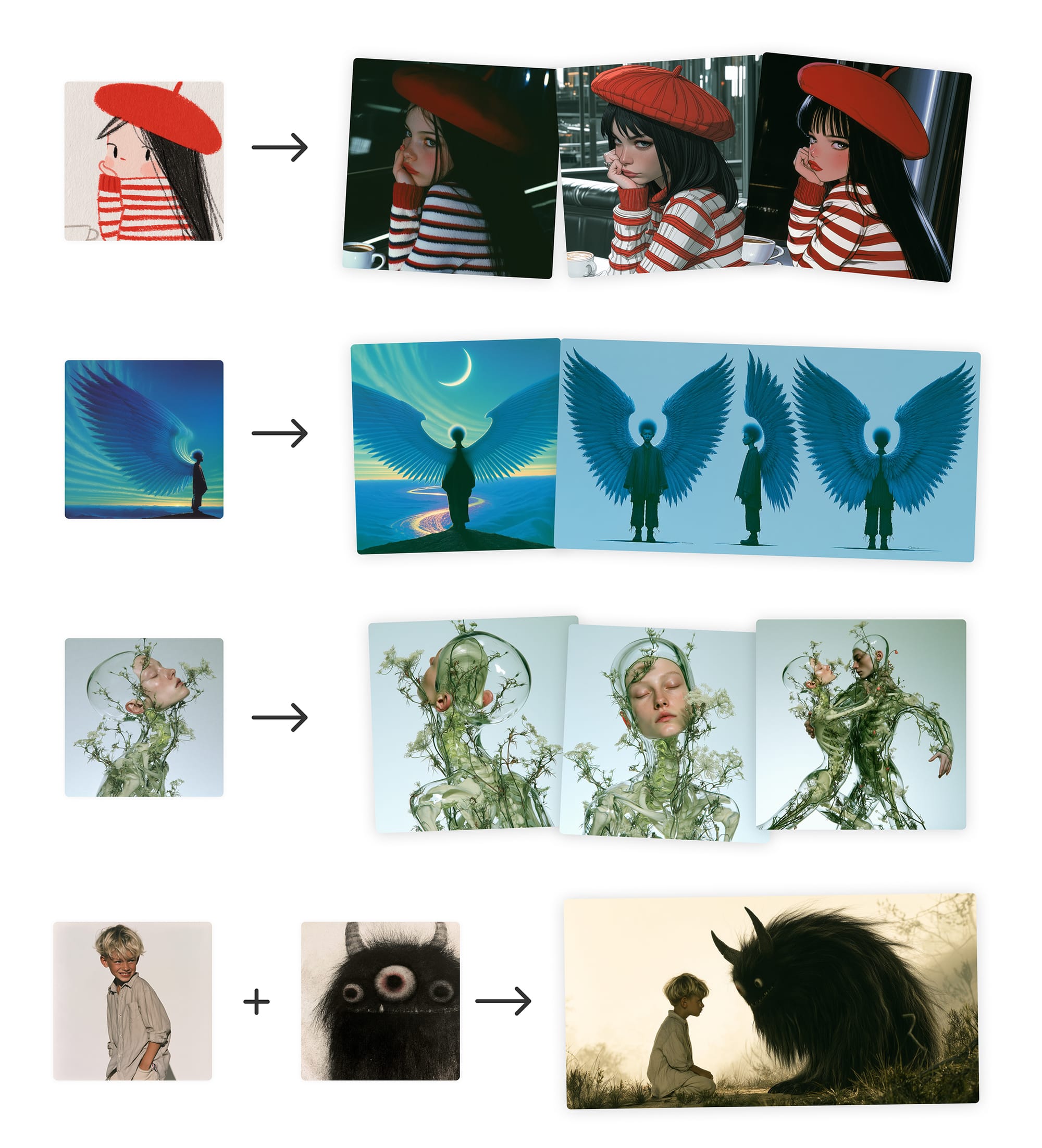
Editing with references
These graphics show reference composition. The announcement describes up to four attachments, while the examples show up to three.
Release announcementThe reference workflow before the public test
Midjourney introduced Omni-Reference in V7 as a way to carry a subject, object, creature or vehicle into a new image. It had a dedicated prompt-bar slot and a weight control. The June V8.1 default-model announcement pointed users to V7 Omni-Reference while Midjourney trained an improved V8 version. V8.2 became the default generator in July. The August public test concerned a separate edit model, in a product that already offered editor controls such as Retexture and inline editing. Omni-Reference announcement · V8.1 default-model announcement · V8.2 release · Prelaunch Alpha changelog
The public test opened on August 28 in Seoul, from a saved publication timestamp of August 27 at 23:32 UTC. Midjourney described up to four image references as the new route for image-guided generation in this model. It also advertised plain-language edits, inpainting, outpainting, and support for personalization, moodboards and style references. Its launch instructions listed the prompt-bar attachment area, lightbox, full web Editor and Discord's --edit command. The announcement advised giving the prompt extra direction when using moodboards or style references and asked testers to report edge cases. Edit Model for V8 announcement
What the launch images actually show
In the first Midjourney graphic, a drawing of a figure with a red beret and striped top becomes three versions that retain the hat, stripes and hand-to-cheek pose across different rendering treatments. A winged character keeps the large blue wings across a changed scene and multiple viewpoints. In the same graphic, separate references of a boy and a horned creature become a new encounter. The boy's clothing and the creature's silhouette carry through, while their poses and scale change to serve the composition. Midjourney launch graphic 1
The second graphic combines a fiery horse, a flower-covered sword and an armored figure into one scene. Each reference contributes a recognizable element. Both graphics are vendor-selected compositions. They illustrate which traits the model could carry into these outputs. The graphics show runs with up to three inputs, and the announced ceiling of four is a separate product claim. The graphics supply no repeated trials or mask-preservation comparison. Midjourney launch graphic 2 · Launch announcement
Early feedback on localized revisions
An August 31 subreddit announcement repeated the feature list and named V8.1 and V8.2 in its title. The body described the tested model as V8.2. On August 30, an Alpha user published a before-and-after report from a different workflow. They had erased and inpainted details of a comet and its landscape over several passes. The broad scene remained recognizable, but the user reported blotching in the star field, which they had largely avoided editing. They had tried multiple version settings. The run's exact backend, mask and prompt remain unknown. Subreddit announcement · Firsthand Alpha inpainting report
Midjourney had already announced an edit-quality update on August 29. On September 3, the same user reported better results while still seeing some off-mask changes after three or four passes on some images. The Alpha changelog published September 3 UTC described the inline V8.2 lightbox with up to four references, session edit history and bug fixes. Later in September, another Alpha changelog explicitly listed V8.1 and V8.2 edit types and HD edit canvases. The user report and the changelogs establish a changing test environment. Which change, if any, explains the user's improvement remains open. Edit quality update · User follow-up in the inpainting thread · Early September Alpha changelog · Late September Alpha changelog
What the workflow changed for design
In GoOnWrite's September 3 examples, giving one input the role of layout and another the role of style worked well enough to explore a cover concept. The author also saw variable palette matching when supplying a color reference. Moving that image to the Style Reference slot produced better results in some examples and worse ones in others. Together with the failed repositioning tests, that gives a practical account of where directing a fresh render helped and where the designer still needed direct manipulation. The author presented sample outputs for premade cover work. Client approval, final delivery and time savings remain unverified. GoOnWrite's palette and composition tests
Reference fidelity in these examples has two distinct tests. For a new composition, the question is whether recognizable traits from different sources survive the render and serve the brief. For a localized change, the question is whether the subject, layout and fine detail outside the target survive each revision. In the available launch evidence, Midjourney showed the first kind of control in selected examples. The Alpha report shows why the second calls for checking the revised image against the original, especially where a small background change would affect approval. Reliability across masks, reference counts, version settings and repeated passes remains unmeasured in these sources. Midjourney's reference composition · Alpha inpainting report